Introduction
Checking a proof is one of the most common and demanding tasks in mathematics, and it becomes especially difficult when the argument spans several fields. Recently, AI has greatly accelerated the production of proofs, making reliable verification ever more important. Proof assistants such as Lean 4 (de Moura and Ullrich, 2021) verify proofs by rewriting a mathematical argument into precise formal code that the computer mechanically checks, thereby ensuring soundness. Although such systems have incorporated automation to reduce the burden of formalization, constructing formal code still requires extensive manual effort and expertise. Recent advances have enabled large language models to formalize, reducing this manual burden, and only very recently have they become capable of doing so at scale. Once a generated formal proof has passed kernel checking under the permitted axioms, the remaining human task is to judge whether its statement, assumptions, and definitions are semantically faithful to the original mathematical content; a reviewer can then verify the result without reconstructing every proof step or mastering every technique used to establish it. Still, expert guidance can be of great help throughout the formalization process in choosing definitions, reviewing statements, assessing code organization, and resolving mathematical difficulties during proof construction.
Early work on autoformalization studied the translation of mathematical statements (Wu et al., 2022; Jiang et al., 2023a; Gao et al., 2025), alongside progress in generating formal proofs (Polu and Sutskever, 2020; Yang et al., 2023; Ren et al., 2025). As language models have become increasingly capable of producing proofs in natural language, the bottleneck has shifted from constructing a proof to translating it into formal code. This shift has enabled an end-to-end pipeline spanning generation, translation, and formal verification, which agent systems sustain through library retrieval, compiler feedback, and repeated task execution (Thakur et al., 2024; Liu et al., 2026; Ju et al., 2026). In parallel, the scale of projects that autoformalization can handle has grown from individual proofs to bodies of interrelated results and textbook-level theories (Urban, 2026; Wang et al., 2026b; Gloeckle et al., 2026). The September 2026 formalization of Fermat’s Last Theorem using Prove2Me produced a complete computer-checked proof of unprecedented scale (Chen et al., 2026b; Anthropic, 2026a), but how such large-scale formalizations are actually organized, and where human and AI effort is divided, is not yet widely understood.
We use the formalization of the Poincaré conjecture as a testing ground for these questions, a project whose scale and scope make it unusually demanding for organizing human and AI effort. The conjecture, proved by Perelman, states that every simply connected, closed three-manifold is homeomorphic to the three-sphere. We follow Morgan–Tian’s detailed exposition (Morgan and Tian, 2007). The proof requires geometric analysis for which Mathlib still lacks mature reusable interfaces, making the building of foundations an essential part of the project.1
Our preparation began in May 2026 with three AI engineers with mathematical training, who worked alongside a group of mathematicians. Over the following months, we developed a natural-language blueprint of the proof and formalized some background material. Drawing on this preparation, we substantially redesigned our workflow and restarted the main formalization in September with about 90 milestones, each specifying the definitions and Lean statement required for its target. The milestones provided shared mathematical targets, exposed dependencies, and made progress and blockers visible. The engineers used this structure to coordinate parallel agent work, while mathematicians reviewed the final theorem and key intermediate statements and helped resolve mathematical difficulties during proof construction.
Using publicly available commercial models, we completed the main formalization phase in slightly more than two weeks, after the initial preparation phase. AI subscriptions and server rentals cost about USD 25,000. The resulting development proves both the topological and smooth Poincaré theorems.2 It passes a full Lean build and Comparator verification against target statements written using only Mathlib.3 The initial development contained about 3.2 million lines of Lean code.4 Extracting the dependencies of the final theorem reduced it to about 2.8 million lines while preserving verification.
Methodology
Our first attempts to formalize material related to the Poincaré conjecture began in May 2026. In September, we redesigned the workflow, restarted the formalization from scratch, and completed the main development in slightly more than two weeks.
During the initial phase, we collected books and papers on Riemannian geometry (do Carmo, 1993; Petersen, 2006; Gallot et al., 2004; Sakai, 1996; Cheeger and Ebin, 1975), algebraic topology (Hatcher, 2002), PDEs (Evans, 2010), three-manifold topology (Schoen and Yau, 1994; Morgan and Tian, 2007), and Ricci flow (Chow and Knopf, 2004; Chow et al., 2006; Hamilton, 1982; Hamilton, 1993; Shi, 1989a; Shi, 1989b; Perelman, 2002; Perelman, 2003a; Perelman, 2003b; Cao and Zhu, 2006). We initially planned to formalize substantial portions of this background before addressing the Poincaré conjecture itself. This approach progressed slowly, and the resulting Lean code did not meet our expectations for quality or organization. The reasons for this difference in performance are discussed in Accelerating the Formalization.
By late July, we had completed a Lean formalization of the Hopf–Rinow theorem and reviewed its mathematical correctness. After an initial attempt with an AI system failed, a mathematician reorganized the proof into a clearer route, enabling the system to complete the development. Throughout August, we continued formalizing foundational material from these sources and completed a natural-language blueprint of the Poincaré proof following Morgan–Tian.
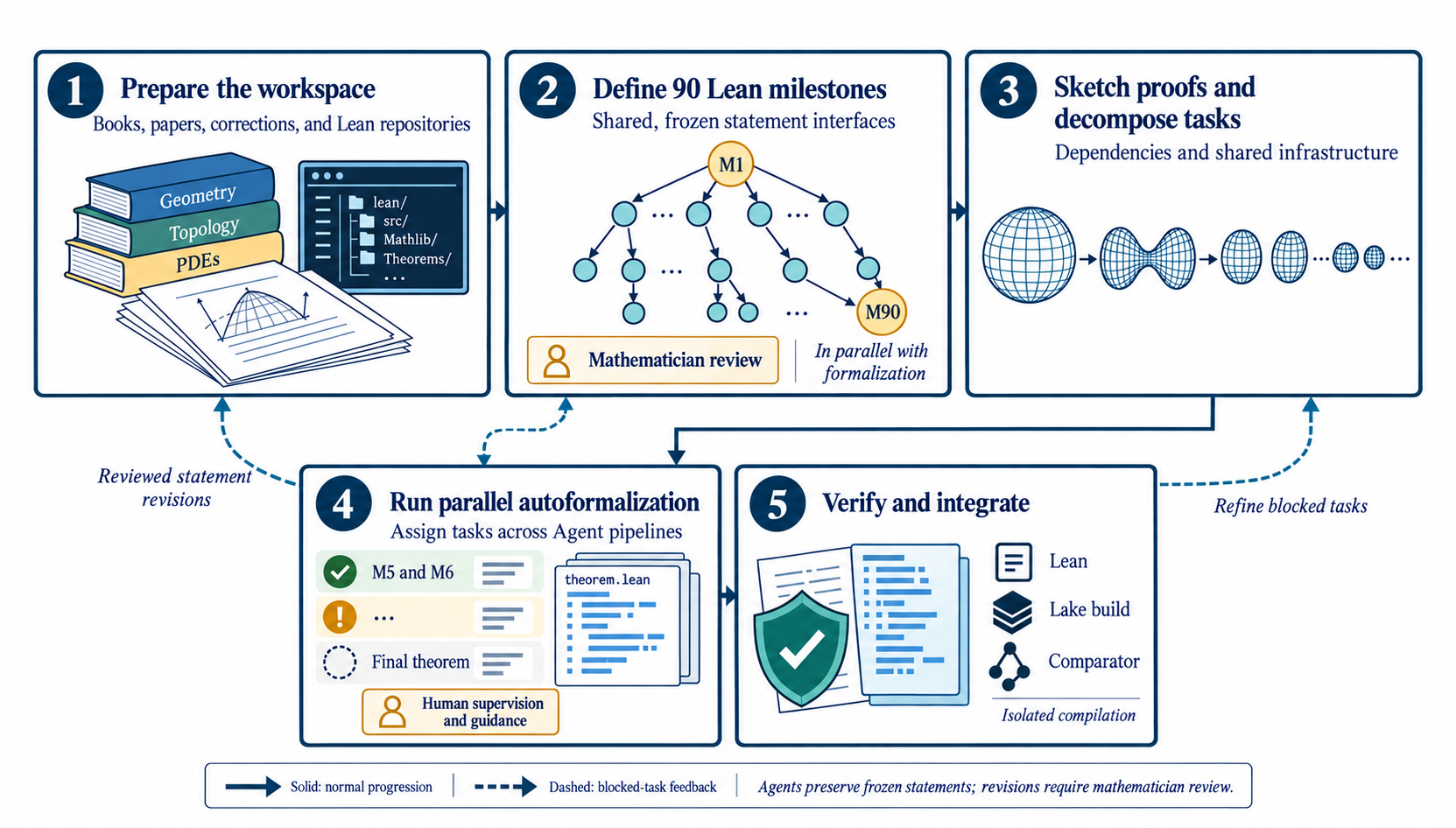
Drawing on this preparation, we redesigned the workflow summarized in Figure 1. We collected the relevant sources, corrections, and repositories, and organized them into a proof skeleton following the Morgan–Tian exposition (Morgan and Tian, 2007). This skeleton consisted of 90 milestones distributed throughout the intended argument. Each milestone included a Lean statement and the definitions required by that statement. The resulting milestone interfaces were then used for parallel work across independent tasks.
The milestone statements were reviewed by mathematicians in parallel with the formalization work. This review established a common standard for the principal results and helped prevent the growing codebase from diverging from the intended mathematics. Since it was not possible to review every line of agent-generated code, the milestone statements provided checkpoints at which the mathematical content could be examined independently of the eventual implementation.
The milestone structure also exposed the dependency chains in the proof. For each milestone, agents were asked to use the mathematical references to produce an informal proof sketch and to identify the results on which the milestone depended. These sketches made dependencies visible and helped group related milestones into larger tasks, for example when several milestones required the same underlying infrastructure. Because the project used several autoformalization pipelines, the reviewed milestone statements also served as common interfaces between those pipelines.
Some tasks required direct human supervision, often simply by bypassing an agent’s self-imposed constraints or correcting a subtle logical gap. Interactive sessions with coding agents such as Codex and Claude Code were used to monitor progress, identify unproductive proof attempts, and diagnose blockers. In many cases, a discussion with the agent was enough to unblock a task. In other cases, supervision exposed an inconsistency in a frozen Lean statement. Such statements were not changed by the agents; the issue was instead reviewed by the relevant mathematicians and corrected at the coordination level.
The human role therefore remained focused on mathematical scope, statement review, task prioritization, and the resolution of exceptional difficulties. This division of labor made it possible to supervise the development at a high level without inspecting every agent action or every line of Lean code. Once a task satisfied its milestone interface, its changes could be merged into the shared repository. This experience showed that the organization of the formalization process was as important as the capabilities of the underlying agents.
Formal Statement Review
Statement review was the checkpoint at which we assessed the mathematical target independently of its proof. For each milestone, reviewers examined whether the definitions, hypotheses, conclusion, and intended dependencies expressed the result required by the proof route. The final theorem statements were kept separate from the supporting proof modules, so that a reviewer could evaluate what Lean was asked to prove without reconstructing an agent’s proof history.
Each statement was accompanied by its mathematical source, relevant corrections, dependencies, and intended level of generality. The review record connected these choices to the corresponding Lean declaration and recorded later revisions. This made statement review a distinct and auditable stage, rather than an inference from successful compilation.
Reviewers compared the natural-language statement with the fixed version of Mathlib and with the requirements of later milestones. External formalizations could suggest definitions or proof interfaces, but any adaptation was checked against the source mathematics and the project’s chosen meanings. Keeping the explanation beside the Lean statement made this comparison direct.
The review had two passes. The first checked the written definitions and statement against the mathematical sources and downstream uses. The second inspected the declaration produced by Lean’s elaborator, including information left implicit in the source code, to detect unintended parameters or assumptions. Statement types were also required to be independent of admitted proofs. These checks validated the target as a basis for proof construction; they did not by themselves prove the theorem.
Mathematicians participated from the statement-design stage and resolved ambiguities before they propagated into dependent tasks. When review found that a shared statement needed correction, the coordinator recorded the revised basis and reopened the affected reviews; unaffected milestones could continue. Human intervention therefore controlled the mathematical scope while preserving the distinction between a reviewed statement and a mechanically checked proof.
Milestone Decomposition and Dependency Management
Milestone design was a joint mathematical and engineering task. Mathematicians selected a coherent proof route, supplied arguments and references, and identified intermediate results that could be reviewed independently. Engineers and Lean experts assessed the available formal infrastructure and the work needed to connect those results in Lean. Named theorems in the Morgan–Tian exposition provided initial landmarks; a usable formalization blueprint also had to specify the definitions, supporting constructions, and dependencies between them. The milestones therefore reflected both the logical structure of the mathematics and the practical organization of its implementation.
In choosing the spacing between milestones, we considered the expected amount of Lean code and prerequisite development. A short deduction on paper may require substantial formal work when suitable definitions, estimates, or links between representations are missing. Such gaps warranted additional intermediate tasks. Conversely, closely related results could share a task when they depended on the same construction. This assessment concerned the work needed to produce a useful, reviewable result, rather than a fixed number of textbook pages or lines of code.
The appropriate level of generality was also a design choice. To simplify formalization, a result could be specialized to dimension three, or restricted to a weaker conclusion, when that was sufficient for every subsequent use. Other milestones benefited from stronger conclusions: returning a constructed object together with the properties needed later could avoid repeated constructions and proofs of compatibility. The annulus and deformation stages illustrate this choice in Mathematical Bottlenecks and Formalization Experience. Such revisions required mathematical review to ensure that the final theorem remained supported and that additional conclusions were proved from justified assumptions. Agents could report a difficulty, but changes to an agreed target were coordinated explicitly.
Each milestone specified its definitions, assumptions, and required outputs before proof assignment. A directed dependency graph recorded which earlier constructions or results each task would use. Shared foundations were assigned to a single owner, and independent tasks were developed in separate workspaces using agreed definitions and statements. As implementation exposed missing prerequisites or unsuitable task boundaries, we revised the graph and the affected assignments while allowing unaffected work to continue.
This structure made expert guidance useful throughout execution. Mathematicians with a high-level view of the proof and relevant formalization-engineering experience could often identify a missing argument, an unsuitable target, or a dependency problem early, and give effective guidance before extensive code accumulated. Engineers could then translate that diagnosis into revised tasks and dependencies. The combination of mathematical judgment, Lean implementation experience, and automated proof construction therefore provided a practical basis for coordinating and reviewing a development too large to inspect line by line.
Agent Execution and Team Coordination
The formalization of the Poincaré conjecture involved three AI engineers, together with mathematicians and Lean experts. As illustrated in Figure 2, each engineer used a distinct combination of models, agent frameworks, and computing resources. This diversity made it possible to use complementary methods of autoformalization, but also required coordination to avoid duplicated work, incompatible interfaces, and conflicting versions of the same result.
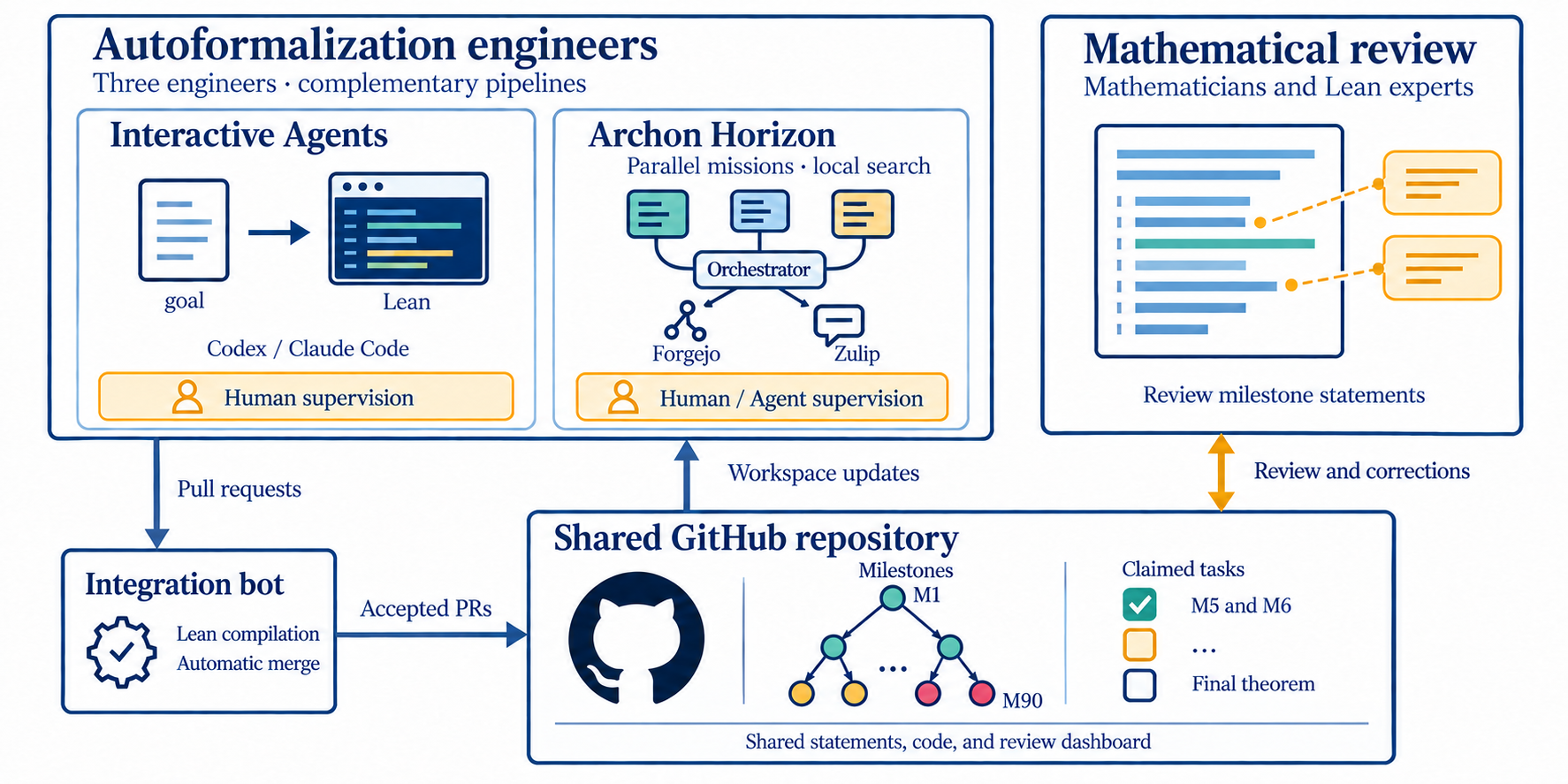
For different scales and failure modes, we primarily used two complementary modes: interactive coding-agent sessions for tightly scoped, high-context interventions, and a distributed mission workflow for proof branches that could be decomposed and run in parallel. The first mode used interactive sessions, principally with Codex and Claude Code. Each session was organized around a proof-branch harness rather than an isolated coding prompt. Before an agent began, an engineer fixed the branch boundary, milestone endpoint, definitions and interfaces to be used, predecessor and consumer dependencies, relevant mathematical sources, expected artifacts, and compilation and admission checks. The engineer then used the session to search and filter the pinned Mathlib APIs and source references, translate the selected argument, monitor the resulting declarations, and revise the route when a mathematical or implementation obstruction appeared. This architecture kept local proof search tied to the surrounding dependency graph. GPT-6-Astra carried most of the long-context statement formalization and proof construction, while Fable-5.1 was used for independent source-alignment checks, diagnosis of blocked branches, and refinement of the proposed harness. This division of labor proved effective in practice: one model could sustain the main construction while the other supplied targeted scrutiny and alternative directions.
The second method used Archon Horizon.5 Archon Horizon is a distributed control plane for formalization projects. It represents a project as a collection of bounded missions with explicit goals, dependencies, and completion conditions, rather than as one long interactive session. Its informal project representation is a directed acyclic graph of Markdown documents. These documents can contain Lean snippets, links to commits and sources, informal proofs, and other task-specific material.
This structure supports parallel execution. Horizon can dispatch independent missions to agents running on different configured servers, while shared repositories and communication channels maintain a common view of the project. This reduces local computing bottlenecks and allows several formalization tasks to progress concurrently. Engineers can still supervise the system through interactive agent sessions: they can inspect progress, supply context, launch or cancel missions, and intervene when a task appears blocked. Horizon therefore combines distributed execution with the possibility of targeted human oversight.
Because the engineers used different methods and servers, coordination required a shared repository. Contributors claimed milestones there and submitted completed work through pull requests. An integration bot independently compiled the Lean code and automatically merged accepted changes. When a peer completed a milestone, the other engineers could incorporate the resulting changes into their own workspaces and continue from the updated development.
The shared repository also supported a review dashboard. Mathematical reviewers could inspect and comment on the formal statement of each milestone. When a review identified an issue, an engineer revised the statement in the main repository before later tasks relied on it. This made review status visible to all participants and allowed corrections to propagate quickly through the formalization workflow.
Project Resources
We now describe the resources behind the project: the models used, the division of labor among them, and the resulting cost. GPT-6-Astra formalized the milestone statements in Lean, and both GPT-6-Astra and Fable-5.1 performed multiple rounds of statement review. Proof construction relied primarily on GPT-6-Astra, with occasional consultation of Fable-5.1.
The cost of AI subscriptions and rented servers was approximately USD 25,000. About USD 20,000 went to AI subscriptions, primarily GPT Pro 20× plans, roughly equivalent to 100 subscriptions at USD 200 each. This subscription equivalent provides only a rough reference for model usage, given quota resets and fluctuations in OpenAI’s usage allowances. The remaining approximately USD 5,000 covered the rental of Linux servers, used mainly for Lean compilation.
Analysis
Agent Behavior and Human Intervention
Agents typically worked through repeated cycles of source and library search, informal reasoning, Lean implementation, and compilation. They assisted with translating arguments, connecting existing results, repairing local proofs, and checking code mechanically. Recurring difficulties arose when a task required judging whether a stronger claim followed from the reference, whether two representations described the same geometric object, or whether an intermediate result would help prove the final theorem. These decisions required review beyond checking whether individual code fragments compiled.
When progress stalled, we found that the difficulties mainly fell into three categories, which helped us address each one at its source:
-
Mathematical gaps. These required a more detailed argument, a suitable reference, or a reviewed correction to the statement or its hypotheses.
-
Lean implementation problems. These called for a better representation, an existing library result, or a lemma relating two definitions.
-
Coordination problems. These included duplicated work, unstable ownership, or incompatible versions of a shared statement, and required changes to assignments or dependencies.
This diagnosis determined whether further proof search was useful and what information an agent needed to proceed.
Engineers used the current dependency graph to assign independent milestones whose statements were sufficiently stable. They monitored ongoing attempts and adjusted the assignments as missing prerequisites became apparent. Mathematical review helped identify which intermediate goals supported the intended argument, allowing unproductive directions to be curtailed while other tasks continued.
Failed attempts also supplied diagnostic evidence. A repeatedly unsuccessful task could be too broad, rely on an unavailable assumption, or require information omitted from an earlier result. Task descriptions, review notes, and progress reports preserved these issues for targeted discussion. Human intervention therefore directed the work as well as reviewing its output: mathematicians clarified the mathematical requirements, engineers organized their implementation, and agents carried out the resulting proof tasks.
Mathematical Bottlenecks and Formalization Experience
Mathematicians contributed to the design and progress of the formalization through choices about scope, proof strategy, and the information passed between tasks. These interventions fall into three recurring classes. First, mathematicians set the scope of an interface: they decide which hypotheses, conclusions, and level of generality are mathematically justified and useful to later milestones. Second, they diagnose proof-route and representation gaps: they identify missing intermediate arguments, select the relevant theorem or local geometric model, and separate a mathematical obstruction from a Lean encoding problem. Third, they manage interfaces and downstream reuse: they expose hidden assumptions, decide when an output should be strengthened for later consumers, and keep dependencies and chronology explicit. The examples below follow this order: M22 concerns scope, M28 concerns a missing proof route, and M64–M65 concern interface correction and reusable output.
The first concerned the scope of intermediate results. In the noncollapsing argument (M22), the uniform estimate for the non-round solutions under consideration was formulated in dimension three, while an auxiliary result about asymptotic volume ratios was retained in general dimension to support induction on dimension. These choices required understanding how each result was proved and used later. Restricting a statement can remove unnecessary work, but retaining generality can also provide the structure needed by the proof itself.
The second concerned a curvature estimate used to analyze singularities of Ricci flow (M28). Its proof required a local limiting construction that was not supplied by the available compactness theorem for complete spaces. Mathematical review identified the missing local compactness argument and the geometric contradiction needed to finish the proof, with references to the relevant source arguments. This turned an apparent failure to apply an existing theorem into explicit supporting tasks, giving agents a clearer route through the analytical difficulty.
The third concerned comparing and deforming families of curves (M64–M65). Review of the annulus comparison required an explicit initial annulus connecting the boundary loops, which subsequent applications had to supply: equal winding around an auxiliary circle did not ensure that such a connection existed. The task also needed more than a statement that a suitable approximation existed. Its output retained a family of polygonal approximations, their error and area bounds, and estimates on the associated evolving curves. The next milestone could then use those same objects and estimates. Mathematical review thus both corrected a missing assumption and identified stronger outputs that made the subsequent formalization easier to organize.
These interventions made expert input actionable: a revised statement, a more detailed proof route, or a reusable construction could guide many subsequent agent steps. The value of mathematical participation lay in identifying what should be formalized and why it was sufficient, while Lean expertise and automated proof construction made those decisions executable and checkable.
Accelerating the Formalization
After redesigning the workflow in September as described in Methodology, we completed the main formalization phase in slightly more than two weeks. This acceleration did not arise simply from asking agents to work faster or from allocating more compute: the earlier project had already produced roughly 500,000 comment-free lines of book-based Lean source, as well as a blueprint and tracked many individual nodes. This earlier source collection was separate from the later full development, whose dependency cone contains about 2.8 million of the original 3.2 million lines. The central change was to turn a comparatively small collection of reviewed milestone statements into fixed interfaces for the entire project.
Earlier tasks were often broad, for example formalizing a chapter, a section of the blueprint, or a node in a dependency graph. Such tasks could produce substantial verified progress while still lacking a precise and independently checkable endpoint, making progress difficult to review and the causes of blockers difficult to identify. In the redesigned workflow, the proof was organized around 90 milestone statements distributed throughout the intended argument. Each statement specified the assumptions and conclusion to be preserved, its dependencies, and the condition under which the corresponding task could be considered complete. The milestone therefore provided a concrete location at which progress could be inspected and the mathematical content reviewed.
The timing of review also changed, mitigating the human-review bottleneck. In the earlier attempts, Lean code was reviewed after it had been formalized, making it difficult for human feedback to shape the tasks assigned to the autoformalization system. In the new workflow, mathematicians reviewed the central milestone statements before, or in parallel with, their formalization. These reviewed statements constrained subsequent agent work and reduced the risk that many locally successful proofs would accumulate around an unsuitable definition or an incorrect formulation of a major result.
The new structure made both progress and blockers easier to understand. For example, the earlier Ricci-flow work encountered separate difficulties in curvature evolution, maximum-principle arguments, derivative estimates, and endpoint regularity. The milestone decomposition made interfaces between these arguments explicit, instead of leaving them as unresolved parts of a single large analytic task. We could then identify whether a blocked task required a missing lemma, a more detailed informal argument, an additional reference, further decomposition, or a revision of the statement.
Frozen milestone statements also made parallel work practical. They were particularly well suited to a framework such as Archon Horizon, which assigns bounded tasks to different agents and servers. Different autoformalization pipelines could work on independent dependency chains while sharing the same definitions and theorem interfaces. Once a task satisfied its milestone interface and compiled in the shared repository, it could be integrated without requiring the other engineers to reconstruct its complete proof history.
In our project records, the milestone structure was associated with three operational changes: it constrained the formalization around reviewed mathematical targets, localized failures, and provided a reliable measure of progress. The earlier work nevertheless remained valuable, since it supplied mathematical sources, initial blueprint material, Lean experience, and a clearer understanding of the forms of decomposition that were required for the final workflow.
Comparison with FLT and Reusability
The recent Anthropic formalization of Fermat’s Last Theorem (FLT) provides a useful comparison because both projects produced an end-to-end Lean verification of a major theorem through coordinated agent work. The two projects began from different foundations, however. Anthropic’s development (Anthropic, 2026a) built on Mathlib (The mathlib Community, 2020), the ongoing Imperial College FLT project (Imperial College London FLT Project, 2026), and the existing formalization of FLT for regular primes (Best et al., 2024). By contrast, the Poincaré project required the construction of project-specific infrastructure for substantial parts of Riemannian geometry, Ricci flow, geometric limits, surgery, and three-manifold topology before the final argument could be formalized.
The projects nevertheless share an important organizational principle. Anthropic reports that early FLT attempts failed in part because agents lost track of the evolving project state. Their successful workflow used Prove2Me (Chen et al., 2026b) to maintain a directed acyclic graph of statements, separate statements from proofs, and support search and reuse through descriptions of the available results (Anthropic, 2026a; Chen et al., 2026b). Our workflow similarly used explicit dependencies and fixed statement interfaces to coordinate parallel proof efforts. The main difference is that our milestones were selected in advance from the Morgan–Tian route and reviewed by mathematicians before, or while, formalization proceeded. These reviewed statements served as stable interfaces between several independent pipelines. This suggests that successful autoformalization depends not only on stronger agents or greater parallelism. Without a sufficiently structured workflow, either approach can eventually reach a point at which accumulated inconsistencies, unresolved dependencies, or loss of project state make a restart necessary, as occurred in the early attempts of both projects. The organization of the project appears to have contributed to this result: careful preparation before formalization, followed by explicit task decomposition, stable interfaces, and coordination throughout execution.
FLT also makes clear the distinction between verifying a final theorem and developing reusable mathematical infrastructure. The released FLT repository describes itself as a research artifact that is not maintained and does not accept contributions (Anthropic, 2026b). Its successful verification does not imply that its definitions, module structure, and proof interfaces are immediately suitable for reuse in later Lean developments. This does not prevent later projects from studying or extracting individual parts of the artifact, but substantial reorganization and mathematical design work may be required before those parts function as a maintained library.
We face a related distinction in the present project. Mathematical review of the central milestone statements was intended both to secure the final theorem and to improve the interfaces around which the code was built. Nevertheless, we do not regard the current development as finished. Its initial decomposition follows the Morgan–Tian exposition (Morgan and Tian, 2007), but the Lean proofs produced by the agents do not always follow the same route as the reference. Analyzing these proof paths, especially around tasks that initially blocked the agents, is part of our future work: they may contain useful alternative arguments, more effective intermediate statements, or mathematical observations that deserve to be recorded independently of the formalization.
We also aim to improve the development as Lean code. A dependency-cone extraction reduced the initial approximately 3.2 million-line development to approximately 2.8 million lines while preserving Comparator verification of the final theorem. This is only a first step. We plan to use our internal analysis and refactoring tools to remove duplication, improve proof structure and documentation, generalize definitions and theorem statements where appropriate, and reorganize the project into a reusable geometric-analysis library. The present formalization is therefore both a verified proof and a checked source from which a more maintainable mathematical library can be developed. Future refactoring may make selected components suitable for direct contribution to maintained libraries such as TauCeti (TauCetiProject, 2026).
Conclusion and Outlook
Using publicly available models, we formalized the Poincaré conjecture together with much of its prerequisite theory. For this project, several months of preparation supplied the proof blueprint and informed the milestone structure. Preparing the milestones required organizing the proof route, dividing it into units of manageable formalization size, and making their dependencies explicit. This structure made parallel work possible and helped us locate problems that required mathematical judgment. Experts provided high-level guidance when statements needed revision or proof attempts stalled. This experience shows that an independent research team can achieve large-scale formal verification with human–AI collaboration. As models improve, we expect them to take on more of the mathematical preparation and substantially shorten the time required by the formalization process.
In the public snapshot, about 48% of the Lean source is devoted to background theory and shared mathematical infrastructure.6 For example, our development of smooth structures on compact connected topological three-manifolds spans about 650,000 lines of Lean, including supporting theory, although Morgan–Tian invokes this classical result in an opening footnote. Reliable, reusable mathematical infrastructure is central to reducing the difficulty and cost of formalization. The key is to provide carefully reviewed definitions and theorem statements that accurately express the intended mathematics and can be reused across projects. Such libraries can reduce the need to rebuild foundational theory in every project. An important direction for future work is to turn the material from this project, including its many intermediate formalizations of results, into a maintained geometric-analysis library. This requires reviewing its mathematical interfaces, removing duplication, and improving its organization and documentation. Its success should be judged by how much work and cost it saves in later formalizations. Meanwhile, the proof blueprint can be refined into a clearer mathematical account of the Poincaré argument, making its dependencies explicit and clarifying the role of its intermediate conclusions.
As proof generation and formal verification become cheaper, we hope that affordable tools will let an independent mathematician easily use formalization to verify their own research: stating goals, preparing milestones, guiding proof construction, reviewing formal statements, and finally obtaining mechanically verified results. At a broader level, formalization can also help clarify and improve mathematics itself. In a separate Laver-function formalization project, our formalization identified corrections and clarifications that were incorporated into a revised paper (Chen et al., 2026a). For the Poincaré conjecture, however, much remains to be done to re-examine its proof mathematically with the help of formalization. The formalization has also revealed potential for mathematical revisions that could correct or simplify parts of the argument and deepen our understanding of its structure. We believe that formalization, if done properly, can help mathematicians reorganize mathematics by clarifying definitions, making dependencies explicit, and revealing connections between arguments. To make this capability accessible to the mathematical community more broadly, we invite mathematicians to carry their high-level mathematical knowledge into human–AI interactions centered on Lean, and to help build the libraries, tools, and practices this development requires.
Acknowledgments
The authors would like to warmly thank Wangjian Jian, Xilun Li, Zhengnan Chen for providing expert mathematical consultation throughout the formalization of the Poincaré conjecture, and Zekun Sheng, Nan Wu, Wanxu Yang, Hongyu Chen for reviewing the statement of the final Poincaré theorem and those of the key intermediate milestones, helping ensure that the formalization targeted the intended mathematics.
Footnotes
-
Outside Mathlib, relevant formal developments were also limited and dispersed across individual projects. An early contribution during our preparatory phase was Chow et al.’s formalization of Hamilton’s three-manifold theorem (Chow et al., 2026). Our Poincaré formalization was developed independently of the contemporaneous work of Qin et al. (Qin et al., 2026). The developments use different Ricci-flow interfaces and final proof assemblies; ours follows separately designed and reviewed milestones based on Morgan–Tian.
The public Lean source tree records selected adaptations from Differential Geometry in Lean 4 (DifferentialGeometry contributors, 2026), including its adapted De Giorgi material (Armstrong and Kempe, 2026a; Armstrong and Kempe, 2026b), as well as from ClassificationOfSurfaces (SF LEAN meetup, 2026), Tau Ceti (TauCetiProject, 2026), and Mathlib (The mathlib Community, 2020). The fixed upstream revisions and file-level scopes are documented in the repository’s
MODIFICATIONS.md. ↩ -
An independent formalization of the Poincaré conjecture was also announced by Ziyang Qin, Yuan Liao, Bennett Chow, Ayush Khaitan, and Jack McCarthy (DifferentialGeometry contributors, 2026). ↩
-
The repository includes the independent target statements and verification instructions. Comparator checks statement agreement and permitted axioms; our configuration also checks the proofs with the independent Nanoda kernel. ↩
-
Both figures count Lean source lines after removing comments, using the versions before and after PR #3, respectively. ↩
-
This classification is based on GPT-6-Astra’s assessment, which we prompted to distinguish source devoted to the Perelman proof from background and supporting theory. The classification refers to commit
3d7318c. Examples include Bishop–Gromov volume comparison, short-time existence for Ricci flow, Shi’s derivative estimates, the Hurewicz theorem, and the smooth Schoenflies theorem in dimension three; representative declarations are listed in Appendix A.1 of the paper. ↩